

Dementia Care at Home: Supporting independence for people with dementia in Oldham
For a person living with dementia, home should be a place of familiarity, independence and security. Supporting independence for people with dementia in Oldham is at the heart of our approach. Changes in perception, memory and orientation can increase risk. Here at Caremark Oldham we consider environmental risks in dementia care assessments to reduce hazards.
Identifying environmental risks
When we provide dementia care in someone’s own home, attention naturally focuses on the care being delivered: medication, nutrition, personal care, mobility and emotional wellbeing. However, there is another important aspect of care that can easily be overlooked, the environment in which that care takes place.
For people receiving domiciliary care support from Caremark Oldham, visiting carers may only be present for a relatively small part of the day. The person may spend many hours navigating their home independently. Consequently, identifying and addressing environmental risks with their support network is essential for supporting independence for people with dementia in Oldham and helping people with dementia feel safe at home in Oldham, which can be just as important as the tasks completed during each care visit.
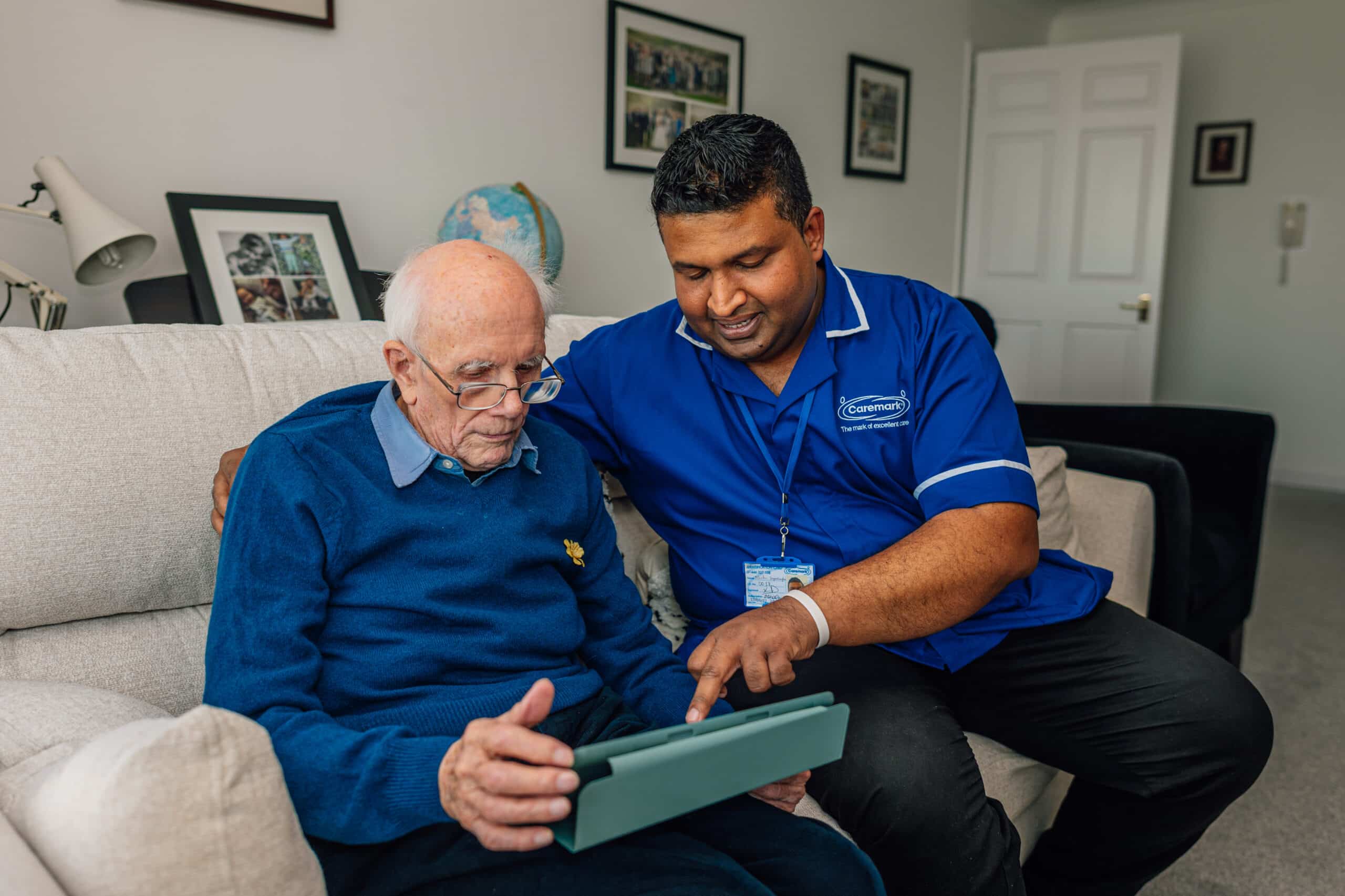
Assessing the home : a safe environment for dementia
Dementia can affect the way a person interprets their surroundings. Changes in visual perception can mean that patterns, reflections, shadows, colours and changes in floor surfaces are interpreted differently.
This is why a dementia care at home environmental assessment needs to ask more than “Is this environment physically safe?”
Instead when we carry out our initial assessment we ask: “How might this environment look and feel to the person living with dementia?”
A shiny floor may appear wet, a dark rug may look like a hole, a patterned carpet may seem uneven, and a darkened hallway may feel unsafe. These differences in perception are important when supporting independence for people with dementia in Oldham and helping people with dementia feel safe at home.
We apply best practice and offer guidance specifically highlighting issues around lighting, flooring, contrast, clutter and wayfinding as important considerations in creating a more dementia-friendly home.
Making a home safer for someone with dementia
Lighting : more than simply turning on a light
Good lighting is fundamental to a safe and supportive environment.
As people age, their visual needs change, and dementia can make it more difficult to interpret shadows and changes in light. Poor lighting can therefore contribute to confusion, anxiety and falls.
When we carry out our customer assessments we look for areas where lighting is inadequate, particularly:
- hallways and corridors
- stairs and landings
- bathrooms and toilets
- entrances and exits
- bedrooms
- areas between the bedroom and bathroom
- places where the person carries out important everyday activities
Good lighting supports independence for people in their own homes, and clear natural light helps create a safer home. However, blocked windows reduce brightness, so our Caremark team would suggest adding lamps or sensor lights to improve visibility. At night, gentle lighting guides movement and reduces confusion.
Flooring : when familiar surfaces become confusing
Another key consideration in our dementia‑related home assessments is flooring. A floor may be level and clean, yet its appearance can still create difficulties. Patterns and shiny surfaces can confuse depth and make floors look unsafe, while dark rugs may seem like holes.
A floor may be level and clean, yet its appearance can still create difficulties. Patterns and shiny surfaces can confuse depth and make floors look unsafe, while dark rugs may seem like holes. Loose rugs and mats can cause trips, so our Caremark team keeps walkways clear of cables and clutter.
After each assessment, our aim is supporting independence for people with dementia in our care by helping them retain a familiar home with reassuring belongings while reducing unnecessary hazards
Contrast can help objects stand out
Something many do not consider is the ability of someone with dementia has to enable them to distinguish between colours and objects
For example something as simple as a white toilet against a pale bathroom may be difficult to identify. Using appropriate colour contrast can help important objects stand out.
We would recommend to our customers that the following to be considered :
- a contrasting toilet seat
- a clearly visible bathroom door
- contrasting light switches
- furniture that contrasts with the floor or wall
- clearly defined stair edges
- contrasting crockery to make food and drink easier to see.
Wayfinding: helping someone find their way around their own home
From our experience we find that one of the most distressing aspects of dementia can be becoming lost or disorientated in a place that was once completely familiar.
As dementia progresses, a person may forget where certain rooms are located, even within their own home, making them feel lost Simple environmental cues can make a significant difference. This is where we would recommend adding clear signs, or simply leaving a light on in the bathroom to help with navigation.
Clutter, noise and overstimulation
Our Caremark team stays mindful of clutter that makes navigation harder, such as trailing cables, overloaded surfaces, piles of paperwork or poorly organised cupboards.
A dementia-friendly home doesn’t need to be minimalist, it should still feel familiar and reassuring.
Therefore, we help customers keep walkways clear and reduce visual distractions.
Noise also matters, as competing sounds from TVs, radios or appliances can make concentration and communication difficult.
By reducing unnecessary clutter and noise, our care assistants create calmer, safer spaces that support independence for people with dementia.
The bathroom: a particularly important environment
The bathroom carries several risks, so our Caremark team pays close attention to how someone uses this space.
Water, hard surfaces and unfamiliar controls can cause confusion, and the room itself may become harder to recognise. Therefore, clear identification helps, and contrasting colours make toilets, sinks and grab rails easier to see.
We also check whether taps and switches are simple to understand and whether the route to the bathroom is visible.
Our aim is supporting independence for people with dementia by helping them use the bathroom safely for as long as possible.
Caremark Oldham’s role as care provider
Our visiting care assistants play a vital role because they see how someone with dementia interacts with their home each day.
An environmental assessment should not simply be completed once and then filed away. Dementia is progressive, and the person’s abilities and interpretation of their surroundings may change.
Instead, our team continually notices changes, such as new hesitation on a floor surface, difficulty finding the kitchen or increased anxiety in a hallway.
These observations help us identify layout, lighting or noise issues that may increase confusion or risk. Therefore, our responsibility is not to redesign a person’s home, but to notice, report, discuss and contribute to practical solutions that support independence for people living at home.
From risk assessment to enablement
There is an important distinction between making a home risk-free and making it dementia-friendly
Removing every possible risk could also remove opportunities for independence.
Caremark Oldham seeks a balance between safety and autonomy. Hence we ask the question: What can we change about the dementia care at home environment so that this person can continue to do as much as possible for themselves?
This approach is central to supporting independence for people with dementia in Oldham and helping people with dementia feel safe at home in Oldham.
Good dementia care therefore extends beyond the care plan and the tasks carried out by the visiting carer. At Caremark Oldham we take the time to understand the relationship between the person, their abilities and the physical environment around them.
The Alzheimer’s Society emphasises that small, thoughtful changes to the home can help people living with dementia remain safe, active and independent, and support them to stay at home with dignity for as long as possible.
Click here to read more guidance from The Alzheimer’s Society.
Local dementia support in Oldham for helping people feel safe at home and supporting independence
Medical & Clinical Support
Oldham Memory Assessment and Treatment Service (The Memory Service):
Provides diagnostic assessments, memory liaison nurses, occupational therapy, and annual reviews.
Click here for more information
Community & Carer Support
AGE UK (Oldham)
Our local branch of AGE UK offers specialist dementia information, carer assessments, day care, shopping services, and also runs many local dementia-friendly social groups.
Click here for more information
Springboard Oldham Dementia Carers Group
Provides a welcoming, face-to-face peer support group, social activities, and trips for people living with dementia and their carers.
This group meets every Thursday 1-3pm at Downey House
Click here for more information
Oldham Council
The local council offers advice & support to people in Oldham living with dementia and their care network, you can find out more by visiting their website, click here.
About Caremark Oldham
If you’re interested in a career in care please look at our current vacancies , or know someone who may need our support at home you can see our services here, we’re always here for a friendly chat.
Email us at Oldham@caremark.co.uk or call 0161 627 0891.